
Last updated:
Short answer: Phoenix citrus does not run on one fixed schedule. University of Arizona Cooperative Extension puts irrigation intervals anywhere from about 7 to 28 days depending on season, soil, tree age, and method. Fertilizer is split into thirds: January-February, March-April, and May-June for oranges, tangerines, and grapefruit, with August-September replacing May-June for lemons and limes.
Phoenix citrus care cannot be reduced to “fertilize three times” or “water weekly.” An orange, grapefruit, lemon, and mandarin of the same height use different amounts of water and nitrogen. A newly planted tree has a different interval from a mature canopy. Soil texture and emitter output change run time. Even bloom timing is evidence: an unusual fall bloom can follow summer water stress.
Why is my citrus tree blooming in fall?
University of Arizona Cooperative Extension explains that citrus often blooms about a month after drought stress if it recovers. So an abnormal bloom in September or October can point back to summer water stress, which is a different thing from the expected principal spring bloom. Record the date, recent heat, irrigation failures, leaf curl, and any fruit drop.
University of Arizona Cooperative Extension explains that citrus often blooms about a month after drought stress if it recovers. An abnormal bloom in September or October can therefore point back to summer water stress. That is a different interpretation from the expected principal spring bloom.
When bloom appears, record the date, canopy section, recent high-temperature period, irrigation failures, leaf curl, and whether fruit also dropped. A few flowers outside the main period do not identify the exact failure, but a strong off-season flush plus a documented dry interval gives a useful direction for the irrigation audit.
Separate a calendar event from a stress response
| Observation | Question it raises | Field evidence to bank | Premature conclusion to avoid |
|---|---|---|---|
| Normal spring bloom across the canopy | Can irrigation and nutrition support fruit set? | Canopy width, emitter output, wetted depth, tree size, and fertilizer record | More flowers always require more fertilizer |
| Heavy September or October bloom | Was there drought stress roughly a month earlier? | Controller history, broken emitters, leaf curl, soil moisture, heat period, and recovery date | That the tree has begun a normal second crop |
| Flowers or small fruit dropping during hot, dry wind | Is water reaching the full root zone? | Wetted footprint, depth, canopy demand, soil, and application volume | That every dropped fruit indicates a nutrient deficiency |
| White crust, leaf-tip burn, or declining roots | Are salts accumulating? | Water source, drainage, emitter placement, soil test, and irrigation depth | That a short daily drip cycle will leach the root zone |
| Cold injury after a localized low | Did the yard microclimate differ from the forecast? | On-site minimum temperature, slope, wall exposure, age, variety, rootstock, and protected tissue | That damaged wood should be pruned immediately |
How much of the root zone should citrus irrigation wet?
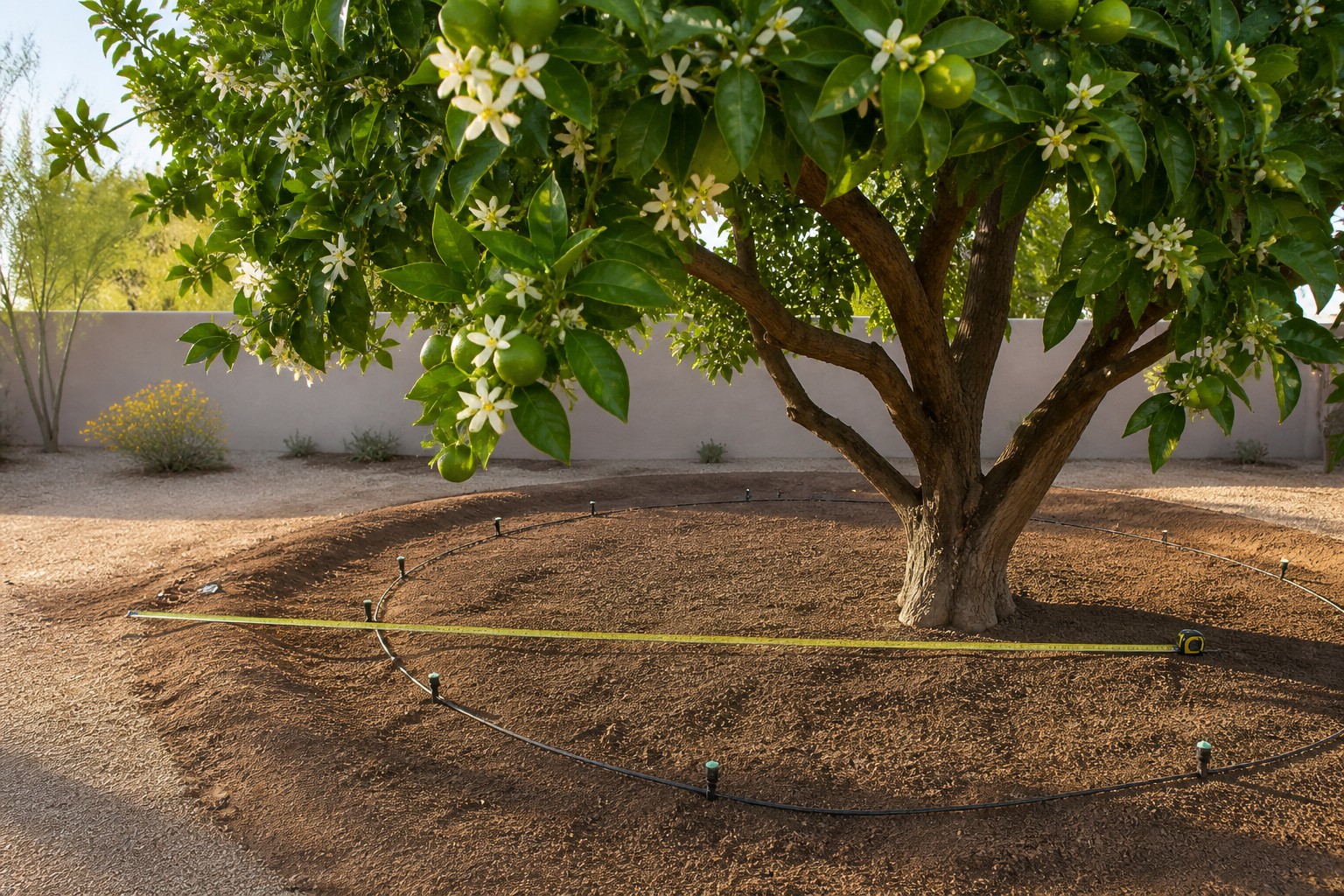
UA recommends wetting from the trunk to just beyond the drip line and to at least two feet deep. Demand starts with canopy diameter, measured drip line to drip line. Lemons and grapefruit use more water than oranges of the same canopy size, while mandarins use less. As the tree grows, add emitters and spread them out.
UA’s citrus water-use method begins with canopy diameter measured from drip line to drip line. Water demand changes sharply with tree size and season. Lemons and grapefruit use more water than oranges of the same canopy size, while mandarins use less. The published table is a demand estimate, not a controller setting.
Map the wetted soil as the tree grows. UA recommends wetting from the trunk to just beyond the drip line and to at least two feet deep. Emitters that remain clustered beside an old planting stake cannot serve a mature canopy. Expand their number and placement so the root zone receives water across a broad area.
For each device, record gallons per hour. Multiply total emitter flow by run time to estimate applied gallons, then confirm with a meter or collection test. The Phoenix irrigation service page can frame emitter repairs, but the accepted result is measured volume and wetted depth—not simply a replaced part.
How often should citrus trees be watered in Phoenix?
UA says citrus irrigation intervals range from about 7 to 28 days, depending on season, soil, tree age, and application method. Young trees and low-volume drip systems can need shorter intervals, while mature basin-irrigated trees can go longer. Let the soil dry to about six inches before the next irrigation, and check that in the actual soil, not from memory.
UA says citrus irrigation intervals range broadly—from about 7 to 28 days—depending on season, soil, tree age, and application method. Young trees and low-volume drip systems can require shorter intervals; mature basin-irrigated trees can go longer. Regardless of interval, the application must reach the active root zone before evaporation removes it.
Frequent shallow watering may leave much of the root system dry and can concentrate salts near the surface. UA advises allowing the soil to dry to about six inches before the next irrigation. Check this in the actual soil rather than setting a repeating interval by memory. The Phoenix soil guide explains why a caliche layer, fill, or coarse pocket can change movement within one yard.
When should citrus trees be fertilized in Phoenix?
For oranges, tangerines, and grapefruit, UA divides the annual nitrogen amount into thirds applied in January-February, March-April, and May-June. Lemons and limes use January-February, March-April, and August-September. Grapefruit and pummelo receive half the chart amount, while lemons and limes receive about ten percent more. The amount itself comes from tree size and the product’s nitrogen percentage.
A fertilizer bag’s first number is the percentage of nitrogen by weight. UA’s citrus chart first classifies the tree by height, trunk diameter, or canopy area, then gives an annual actual-nitrogen range. The product weight is calculated from that nitrogen percentage. Two products with different first numbers cannot be applied pound-for-pound.
For oranges, tangerines, and grapefruit, UA divides the annual amount into thirds applied in January-February, March-April, and May-June. Lemons and limes use January-February, March-April, and August-September. The species adjustment also matters: grapefruit and pummelo receive half the chart amount, while lemons and limes receive about ten percent more.
This is why a calendar date alone is insufficient. The tree measurement, species, annual actual-nitrogen target, product analysis, and amount already applied all belong on the work record. Measure accurately, distribute the material as directed, keep it off the trunk, and irrigate afterward in accordance with the label and site plan.
New trees do not receive the mature-tree formula
UA’s chart assigns a newly planted tree none to only a small amount of actual nitrogen, after establishment and new growth emerge. Applying the mature-tree schedule to a new root system is not faster establishment. Record the planting date and first new growth before considering a measured application.
Coordinate fertilizer with the installation details on the Phoenix landscape-design page. The root flare, graft union, nursery stake removal, irrigation layout, soil interface, and future canopy space are more important on day one than fruit production.
Salt management requires depth and drainage
Citrus has moderate salt tolerance, but salts can accumulate in soil and on foliage. UA notes that poorly drained clay or silt increases the problem, and frequent shallow irrigation can leave a white crust at the surface or salts in the root zone. Water contacting foliage can also burn leaves.
Do not respond to salt symptoms by adding another amendment without testing. Identify the water source, check drainage, inspect emitter clogging, and obtain soil or water analysis where necessary. Leaching requires enough water to move salts below roots and a site where that water can drain safely; it cannot be prescribed without the soil and drainage condition.
Heavy imported mulch is not UA’s citrus default
Mulch is often recommended around desert trees, but UA’s citrus-specific irrigation publication cautions that heavy mulch can create soil conditions that promote disease and says mulch other than the tree’s own leaf litter is no longer recommended. It instead emphasizes canopy shade, a properly wetted root zone, and deep irrigation.
That species-specific guidance should take priority over a copied landscape standard. Keep soil and material away from the trunk, preserve the root flare, and do not bury the graft union.
Frost planning starts with the yard’s cold pocket
UA’s frost guidance says site selection, variety, rootstock, and acclimation are the most important defenses. Slope, surrounding paving, walls, and cold-air drainage can make the temperature at one tree differ from a regional forecast. Place a minimum thermometer near the canopy and compare it with the reported low before a cold event.
Protect the vital trunk of young citrus when appropriate, manage irrigation evenly, and avoid leaving covers on permanently. After cold damage, UA advises waiting until spring to prune so the true boundary of living wood becomes visible. Add frost readiness to the seasonal tasks in the Phoenix landscaping calendar.
A citrus service record should reproduce every decision
- Identity: species, cultivar, rootstock if known, planting date, and source.
- Measurements: canopy diameter, canopy area, height, trunk diameter, and root-zone boundary.
- Water: device count, flow per device, run time, applied gallons, interval, wetted width, and depth.
- Nutrition: annual actual-nitrogen target, product analysis, product weight, split dates, and measured applications.
- Phenology: principal bloom, off-season bloom, fruit set, drop, harvest, and leaf symptoms.
- Weather: heat or cold event, on-site minimum, wind, rainfall, and resulting damage.
This record turns a generic annual calendar into a tree-specific operating system. When fruit drops or leaves curl, the prior thirty days are available for diagnosis instead of guesswork.
Phoenix citrus questions
When do orange trees normally bloom in Phoenix?
The principal bloom is generally in spring. UA notes that a strong abnormal bloom in September or October can follow summer drought stress by about a month, so the date should be treated as diagnostic evidence.
Should citrus be watered every day in summer?
No universal daily schedule applies. UA uses tree age, canopy size, soil, season, and irrigation method, with deeper applications and drying between events. Measure emitter output and wetted depth.
When should a Phoenix lemon tree be fertilized?
UA splits the measured annual amount into thirds in January-February, March-April, and August-September for lemons and limes. The amount comes from tree size and the product’s nitrogen percentage.
Can I prune frost-damaged citrus immediately?
UA advises waiting until spring. Delayed pruning allows the living-versus-dead boundary to become clear and avoids stimulating vulnerable growth during the cold period.
Sources and calculation boundary
- University of Arizona Cooperative Extension: Irrigating Citrus Trees — canopy-based demand, root-zone depth, interval, salt, emitter, basin, and citrus-specific mulch guidance.
- University of Arizona Cooperative Extension: Citrus Fertilization Chart for Arizona — actual nitrogen, tree measurements, species adjustments, and split timing.
- University of Arizona Cooperative Extension: Diagnosing Home Citrus Problems — symptom and fruit-drop context.
- University of Arizona Cooperative Extension: Frost Protection — microclimate, trunk protection, covers, irrigation, and delayed pruning.