
Field condition: What should the irrigation proposal document for Phoenix?
Start the Phoenix irrigation proposal from site evidence instead of assumptions: map what exists, what is requested, and what remains uncertain. Obtain written methods, options, fees, dependencies, and cancellation rules.
Irrigation in Phoenix is a planning, permit and hiring question first. A new system, a drip conversion or a backflow connection involves city permit rules and an Arizona contractor licence, and the money gets wasted when the scope is vague. Call (602) 782-5412 or send your details through the free quote form and we will help you scope it.
Plenty of homeowners start with a broken head or a water bill that jumped, and end up asking a bigger question: should this system be rebuilt for the desert? This page is for that decision. It covers what a Phoenix irrigation project actually involves, which rules the City of Phoenix and the State of Arizona put around it, what to ask in a quote, and how to run the process step by step, with the sources named so you can check them.
What does irrigation planning cover in Phoenix?
Irrigation planning covers the decisions made before any pipe is touched: what you are watering, how much water each area needs, how zones are grouped, what controller runs them, which city rules apply, and who is licensed to do the work. A good plan is a drawing and a scope, not a guess.
The Valley is a hard place to water well. Rainfall is only around eight inches a year according to our own cost guide, summer heat is brutal, and a monsoon storm can drop more water in an afternoon than the system delivers in a week. A system that ignores that swing wastes money in July and drowns roots in August. Planning is where you decide how the system will adapt to both.
A solid irrigation plan records:
- What is being watered. Turf, trees, shrubs, cactus, containers, a vegetable bed. Each has a different demand.
- Zones and hydrozones. Plants with similar water needs sit on the same valve so one group is not overwatered to keep another alive.
- Delivery method. Drip for beds and trees, spray or rotor delivery for turf, and where each starts and stops.
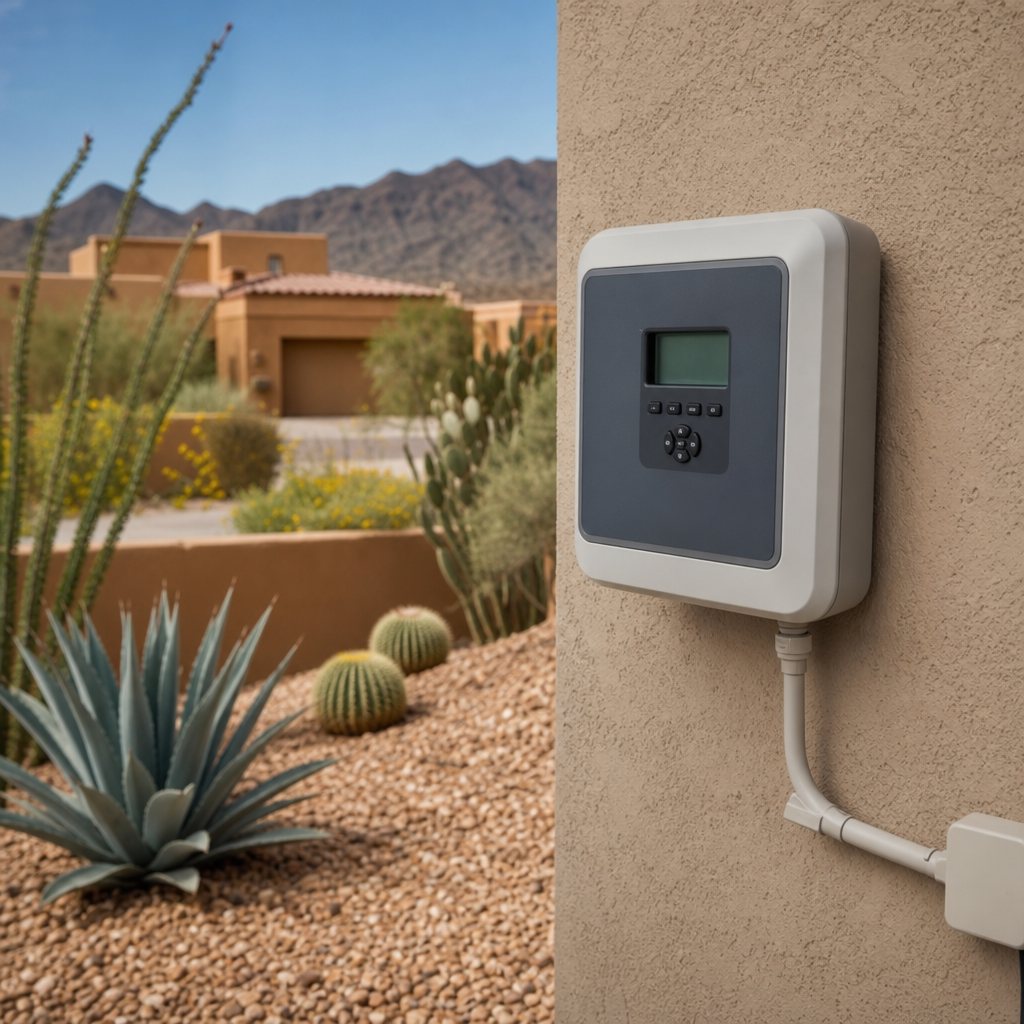
- Control. A timer, a smart controller, a rain sensor, and who adjusts the schedule by season.
- Water connection and backflow. Where the system ties into the water line and how drinking water is protected.
- Approvals and licence. City permits where they apply, and a contractor who holds the right Arizona licence.
Does an irrigation system need a permit in Phoenix?
A permit from the City of Phoenix Planning and Development Department is required to put in any backflow prevention assembly, and assemblies must be tested annually by a certified tester. Replacing a few heads is a different matter. Ask the city before tying new irrigation into your water line.
Our Phoenix landscaping permits guide summarizes the City Code Chapter 37 backflow rules. In short, Phoenix runs a backflow prevention program to protect the drinking water supply. A typical home irrigation system uses a pressure vacuum breaker, while a system with chemical injection needs a reduced pressure assembly. The secondary containment rules generally do not apply to single-family homes used solely as residences, but the plumbing code’s cross-connection rules still do.
The practical effect is that any project that adds or changes how the system connects to your water supply should be treated as a permitted job until the city says otherwise. That includes a new system, a new zone tied to the main line, or moving or replacing the backflow device itself. Repairing a broken head or swapping a nozzle sits at the other end of the scale.
| Irrigation task | What to expect |
|---|---|
| Replace a head, nozzle or emitter | Routine maintenance; no change to how the system connects to the water supply |
| Add drip to an existing zone | Scope it on the plan; confirm with the city if the water connection changes |
| New backflow prevention assembly | City permit from Planning and Development, annual test by a certified tester |
| New system tied into the water line | Treat as permitted; ask the city, and hire a properly licensed contractor |
| Chemical injection (fertilizer injectors) | Reduced pressure assembly rather than a pressure vacuum breaker |
Who is allowed to take an irrigation job in Arizona?
Under A.R.S. 32-1121, the small-job exemption covers only casual or minor work totaling less than $1,000 in labor and materials, and it does not apply where a local permit is required or a larger job is split into pieces. Most new systems and conversions need a contractor with an Arizona licence.
That statute is the state’s list of who does not have to hold a contractor licence. The paragraph that matters here covers work whose aggregate contract price, including labor, materials and all other items, is under $1,000, and only work of a casual or minor nature. It carves out any job that requires a local building permit, and any larger project divided into small contracts to avoid the rule. A person using the exemption has to disclose their unlicensed status in advertising.
To check someone you are thinking of hiring:
- Ask for the Arizona contractor licence number in writing, on the quote.
- Look it up yourself on the Registrar of Contractors website at roc.az.gov.
- Confirm that the licence is active, that the classification covers irrigation work, and read the complaint history.
- Ask for current certificates of insurance sent directly from the insurer.
Our guide to choosing a Phoenix landscaper covers the same lookup, and the red flags that go with it. We should be plain about our role: Phoenix Pro Landscape does not present itself as the licensed contractor for irrigation construction. What we do on this page is help you plan the scope, understand the permit path and compare quotes, and the licensed contractor you pick performs the work under their own licence.
What does the irrigation planning process look like, step by step?
It runs in seven steps: list what you are watering, walk the system and note what is failing, decide what to keep or convert, draw the zones, get line-item quotes from licensed contractors, confirm permits, then test and tune after the work. You make the decisions early, and approvals are the long waits.
- List what you are watering. Turf areas, trees, beds, containers. Note which plants are thirsty and which are desert-adapted. Your call. Typical time: an evening.
- Walk the system and record what is failing. Run each zone for a few minutes. Note broken heads, geysers, dry patches, soggy spots, valve boxes that are buried or cracked, and what the controller is actually set to. Typical time: one to two hours.
- Decide what to keep, repair or convert. If you are replacing grass with desert plants, the delivery method changes. This is the biggest decision and it should be settled before quotes. Typical time: a few days of thought and a conversation with your designer or us.
- Draw the zones. Group plants with similar demand on the same valve. Show where drip starts and stops, where the backflow device sits and where the controller lives. Typical time: a few days.
- Collect line-item quotes. Get two or three quotes from contractors who hold the right Arizona licence, and verify each licence number. You choose the contractor and the controller features. Typical time: one to three weeks.
- Confirm the permit path. Ask the city about any backflow or water connection work and who pulls the permit. Typical time: varies by city queue, so ask for a current estimate.
- Test and tune. After the work, run every zone, check coverage and pressure, confirm the controller schedule, and have any required backflow test documented. Revisit the schedule at the change of season. Typical time: an hour for the walk-through, then a seasonal check.
How much should I water a Phoenix desert yard?
Water deeply and infrequently, then adjust by season. That is the City of Phoenix’s guidance, built on its Landscape Watering by the Numbers program. A long soak followed by a real drying-out period suits desert soils and desert-adapted plants, while shallow daily sprinkling grows shallow roots and evaporates.
The city publishes an interactive plant and lawn watering guide, and it is worth setting the controller from those numbers rather than from habit. Our watering restrictions page notes that most established desert trees and shrubs need water no more than once a week even in peak summer, and that turf is best watered in the early morning hours in the hot months. Check that page for the current drought stage before you rely on any schedule.
Does Phoenix have watering days or restrictions I need to plan around?
As of October 6, 2026 the City of Phoenix is in Stage 1, a Water Alert, which is voluntary conservation with no assigned watering days. Chapter 37 of the city code covers water waste year-round, so runoff into the street, watering pavement and broken heads spraying a sidewalk can still draw attention.
Stage 1 is a warning, not a schedule. Stages 2 through 4 can add audits, surcharges and mandatory limits, so the stage can change with Colorado River conditions. That is why we suggest building a system that would still work if rules tighten: drip where it belongs, zones grouped by demand, and a controller that is easy to adjust. Details are on our watering rules guide, which was verified against the City’s Drought Dashboard on October 6, 2026.
Is drip irrigation the right choice for a Phoenix yard?
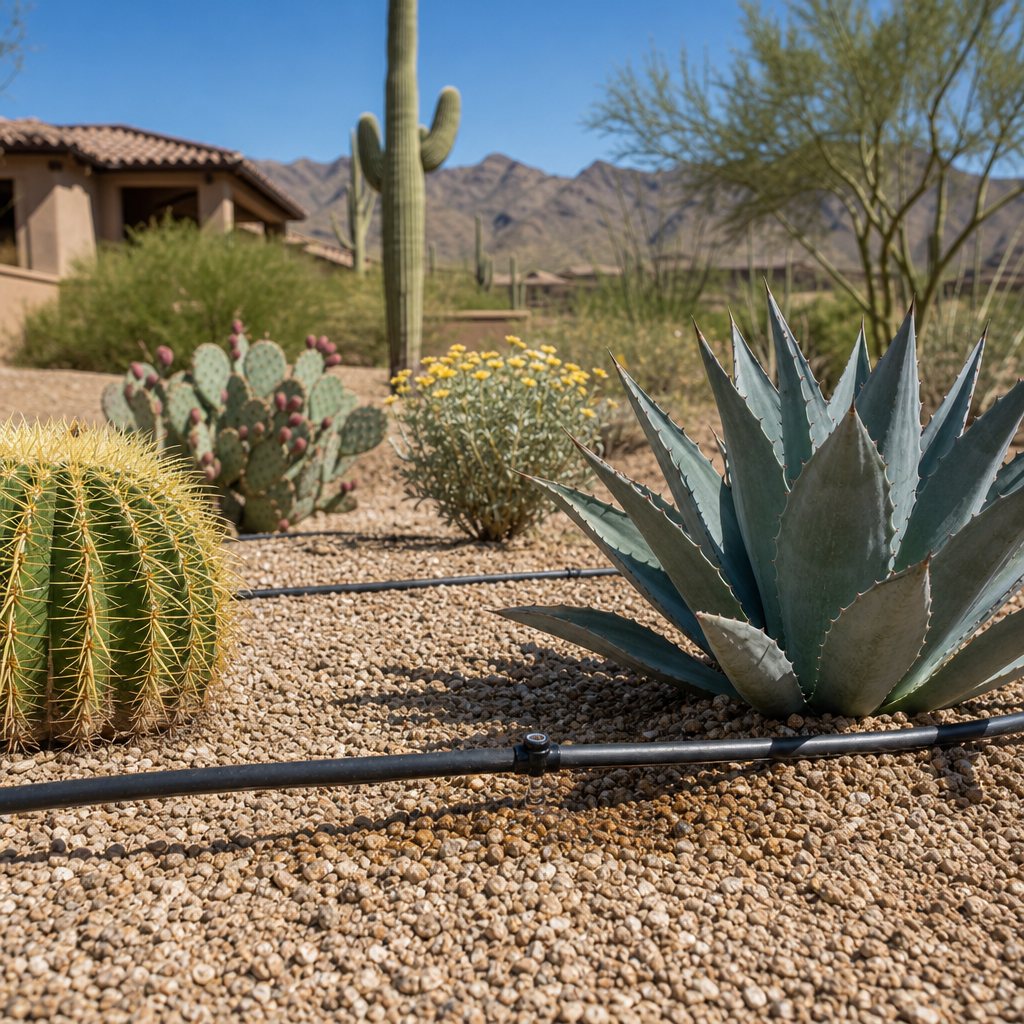
For beds, trees and desert plantings, usually yes. Drip delivers water to the root zone slowly, which suits a climate with about eight inches of rain a year and gives you control over how much each plant gets. Turf areas are the exception, since lawns generally need spray or rotor coverage.
Our xeriscape versus grass comparison explains why converting thirsty turf to desert-adapted planting on drip is where most of the water savings come from. Our watering restrictions page notes that outdoor irrigation is the largest part of most Phoenix homes’ water use. A drip layout still needs planning: filter, pressure regulation, emitter choice by plant, and a place to flush the lines. Ask any bidder to show those on the plan.
How does caliche affect an irrigation project?
Caliche is a cemented calcium carbonate layer that restricts drainage and can stop trenching and planting holes. It affects where water goes after it leaves an emitter. Water that cannot pass through can perch above it, so a plant in a hole that stops at caliche can drown in a desert.
Our Phoenix soil guide quotes University of Arizona Cooperative Extension on testing drainage: fill a planting hole with water, and if the level drops at least four inches in four hours the drainage is adequate. For irrigation planning, that means a quote should say what happens if trenching or a planting hole meets caliche, and the zone design should favor deeper, less frequent watering where drainage genuinely exists. Drip is the delivery method that makes that control possible.
What should an irrigation quote include?
A comparable quote lists the number of zones, the delivery method for each, the controller model and features, the backflow device and who pulls its permit, any trenching and surface restoration, and how the work is staged and paid for. Ask for quantities and named components, not an allowance or a lump sum.
Use the same questions with every bidder:
- What is your Arizona licence number and classification?
- How many zones, and what plants does each serve?
- Which controller, and does it adjust for weather without my help?
- How is the system connected to my water supply, and who handles the backflow permit and test?
- What happens if you hit caliche or an unmarked line?
- How are payments staged, and what is the deposit?
Be wary of large cash deposits before materials arrive and of any suggestion to skip a permit to bring the price down. For general budgeting, our Phoenix landscaping cost guide is the place to start.
Can irrigation changes be coordinated with a hardscape or design project?
Yes, and they should be. Drip lines and valve boxes under a new patio or wall have to be rerouted, capped or sleeved before the base goes in, or they end up buried where nobody can reach them. Settle the irrigation plan at the same time as the design.
The plant choices in a landscape design drive the zone layout, and anything hard that sits on top of existing lines is covered on our hardscaping planning page. Sequence matters: design sets the layout, hardscape sets the permanent structure, and irrigation goes in before planting so nothing has to be dug up later.
Are there rebates for converting grass to desert planting?
Arizona water providers and the Water Use It Wisely program offer grass-removal and landscape rebates that can offset part of a conversion, according to our cost guide. Programs, amounts and eligibility change, so confirm the current terms with your water provider before you remove any turf.
The usual rule with rebate programs is to apply and be approved before work starts. If irrigation is being reworked as part of the conversion, give your provider the whole scope so the application matches what actually happens, and keep any HOA review in the schedule as a separate step.
When is the best time of year to rework a Phoenix irrigation system?
Spring is the time to get the system audited before summer, because June is a poor month to discover a bad valve. Fall is the best planting window for desert-adapted trees and shrubs, so conversion work fits well in early fall. Winter needs very little irrigation, so it is a good time to plan.
This follows the seasonal pattern in our watering guidance: step watering up gradually in March to May, water pre-dawn, deep and infrequently from June to August, and shut the system off after a real monsoon rain. If you want new plantings established by May, the planning call happens in winter, quotes in hand by January, and the work scheduled in the cooler window.
Which parts of the Valley does this guidance cover?
The permit and water rules on this page are City of Phoenix rules, so the steps are written for Phoenix addresses. Homeowners in Scottsdale, Tempe, Mesa and other cities can follow the same process, but each city has its own water provider, rules and permit office, so check with yours.
If you are in a neighboring suburb, start with the matching page: Scottsdale, Tempe or Mesa. The full list is on our areas we serve page.
Three typical planning scenarios
These illustrate how the planning path changes with the project. They are not write-ups of particular jobs.
A typical established yard with a failing system
The walk-through usually finds a handful of broken heads, one zone with low pressure, and a controller still on a schedule from years ago. The decision is whether repair and re-tune is enough or whether the zones themselves no longer match what is planted. Often a smart controller and a few zone changes solve most of it.
A typical turf-to-desert conversion
The grass comes out, the plants change, and the delivery method changes with them. The planning work is zone design by plant demand, a drainage check where caliche may sit, and confirming any rebate terms before the turf is removed. This is where a drawing pays for itself.
A typical new backyard with a water connection
A new yard has no system to inherit, so everything is on the plan: zones, controller, and the backflow assembly. The permit path and the annual backflow test are part of the cost and the calendar, and the contractor should be able to say who handles each.
What should I ask the city before I hire anyone?
Ask whether the project needs a permit at your address, whether a backflow assembly is involved and what test schedule applies, and what the current review time is. The Planning and Development Department can answer those questions before you sign a contract, and asking costs nothing.
Bring a short description of the work, whether any new connection to the water line is involved, and any irrigation changes tied to a wall or patio. If you live in an HOA, ask for its review packet at the same time, because HOA approval does not replace a city permit and a permit does not replace HOA approval.
Next step: scope your Phoenix irrigation project
Call (602) 782-5412 or use the free quote form with a short description of what you are watering, what is failing and whether a conversion is on the table. We will help you turn it into a scope and an approvals checklist so the quotes you collect are comparable.
This page is general planning guidance from a local landscaping team, not legal advice. Rules change and lots differ, so confirm your project with the City of Phoenix before work starts.
What is the difference between irrigation repair and irrigation installation in Phoenix?
Repair fixes parts of an existing system, such as heads, nozzles, emitters and valves, and usually does not change how it ties into the water supply. Installation adds zones or a new connection, which brings backflow, permit and Arizona contractor licensing questions. Plan the two as different scopes.
Who does drip irrigation installation in Phoenix?
A contractor holding an Arizona licence that covers irrigation does it, and you can verify the licence at roc.az.gov. Phoenix Pro Landscape does not present itself as that contractor. It helps you scope a drip conversion, understand the permit path and compare written quotes from licensed firms.
The same lookup is covered in our guide to choosing a Phoenix landscaper.
What should be decided before irrigation installation in Phoenix?
The plan should list what is being watered, zones grouped by plant demand, drip or spray for each area, the controller, and where the backflow assembly sits. The city requires a permit for any backflow prevention assembly, tested annually by a certified tester. Settle those points before collecting quotes.
Plant choices that feed the zone plan are on our landscape design page.
Where do commercial irrigation repairs fit in a Phoenix maintenance contract?
Routine checks of drip lines, valve boxes and backflow assemblies belong in the monthly scope, while repairs are usually priced separately once found. Chapter 37 of the Phoenix city code treats a broken head spraying pavement as water waste, so those repairs come first on a commercial site.
Property-level scopes are laid out on our commercial landscaping page.
How often should a Phoenix irrigation controller be adjusted?
At least four times a year, according to the Arizona Municipal Water Users Association. Summer, monsoon and winter demands are very different, so a seasonal reset belongs in the plan. A controller nobody has touched since it was first set is the usual cause of wasted water.
Current stage and seasonal guidance are on our Phoenix watering restrictions page.
What does a Phoenix irrigation repair cost?
Our Phoenix cost guide lists drip repairs and emitter service at $100 to $400, and a smart controller upgrade at $200 to $500. Those are published ranges for repair and controller work, not installation prices. Ask any repair quote to name the parts replaced and whether a diagnostic visit is separate.
See the 2026 Phoenix landscaping cost guide for the full list.
What field evidence supports a property decision on Irrigation?
Start the Phoenix irrigation proposal from site evidence instead of assumptions: map what exists, what is requested, and what remains uncertain. Obtain written methods, options, fees, dependencies, and cancellation rules.
“Our Phoenix crew runs Irrigation across Maricopa County every week. Same teams, same schedule, same standard.”— Phoenix Pro Landscape Operations Team
- Professionally managed local crews on dedicated weekly routes
- Serving multiple Maricopa County suburbs on fixed route schedules
- Operator-grade scheduling and reporting
- Free written estimates on every job