
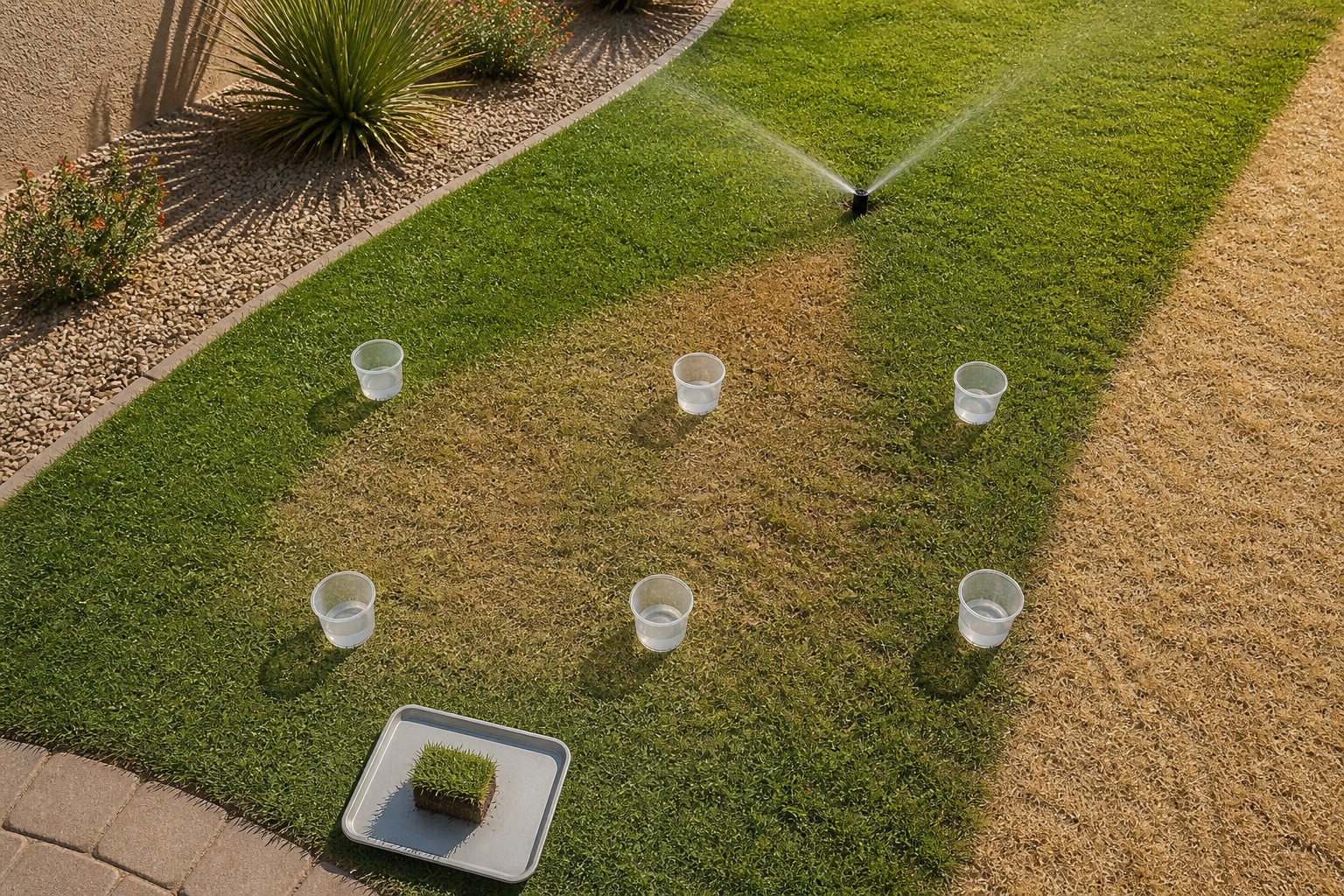
A brown patch in a Phoenix lawn is a symptom, not a diagnosis. Non-overseeded bermudagrass naturally turns straw colored after cold weather. A sharp wedge can trace a sprinkler’s weak arc. A strip along hot pavement may dry faster than the center. Transitioning ryegrass can shade bermudagrass in spring. Disease, insects, chemical injury, compaction, and root damage remain possible, but none should be assumed from color alone.
The season changes what brown means
University of Arizona Cooperative Extension says common and hybrid bermudagrasses grow vigorously in summer and normally go dormant in winter. Frost or several very cold nights turn the turf “blonde.” If the entire non-overseeded lawn changes together in that season, the color can be dormancy rather than loss.
An overseeded lawn has a different calendar. Perennial ryegrass supplies winter color while bermudagrass rests below. Spring is then a competition: cool-season turf may remain green as bermudagrass tries to resume growth. UA warns there is a narrow balance between pushing the ryegrass with water or fertilizer and allowing heat, lower mowing, and seasonal conditions to favor bermudagrass.
Start the field record with one of four states: summer bermudagrass, winter dormant bermudagrass, winter ryegrass over bermudagrass, or spring transition. The Phoenix landscape calendar helps place the observation, but actual soil temperature, shade, and recent weather still matter.
Read the outline before touching the controller
| Pattern on the lawn | First hypothesis to test | Evidence to collect | What not to conclude yet |
|---|---|---|---|
| Most non-overseeded bermudagrass turns evenly tan after cold nights | Seasonal dormancy | Grass identity, frost timing, live crowns, and comparison with protected warm edges | That the lawn is dead or needs daily winter water |
| Wedge, arc, or dry island aligned with a head | Poor distribution, blocked arc, wrong nozzle, or pressure issue | Head-to-head coverage, catch-cup amounts, spray direction, and run time | That soil or fungus created the geometric outline |
| Narrow band beside west-facing masonry or pavement | Reflected heat and faster drying | Surface temperature, moisture depth, shade time, and sprinkler reach | That the whole zone needs more water |
| Green ryegrass persists while bermudagrass returns unevenly | Spring transition competition or shade | Turf species, canopy density, soil warmth, mowing height, and fertilization history | That every pale bermudagrass area has a disease |
| Patch expands independent of irrigation geometry | Root, crown, pest, disease, chemical, or soil problem | Close margin photos, roots, crowns, odor, lesions, insects, soil moisture, and recent applications | Which product should be applied |
Watch the system run from start to finish
A controller screen cannot prove water reached the grass. Run the affected station during calm conditions and watch every head rise. Look for one head that stays low, a nozzle blocked by turf, an arc aimed at pavement, misting from excess pressure, a rotor that stops, or a repaired head with a different precipitation rate from its neighbors.
The City of Phoenix recommends dedicated zones for high-water turf, grouping plants with like watering needs, reducing overspray onto hard surfaces, and resetting controllers as temperature, wind, and weather change. A lawn sharing a valve with drip emitters cannot be evaluated by controller minutes alone because the delivery devices behave differently.
Use the Phoenix irrigation page to define a repair scope. The brown-patch record should identify the exact zone, heads, nozzle types, pressure symptoms, and boundary. Do not authorize a whole-system replacement from one dry area without testing the rest.
A catch-cup test turns green versus brown into measurements
Place identical straight-sided containers across the affected zone: some in green turf, some at the margin, and some inside the brown area. Run the station for a recorded interval in low wind. Measure the depth in each cup and map it to position. The important first result is uniformity—whether one part of the zone consistently receives less—rather than a universal number of controller minutes.
Repeat after repairing or adjusting heads. If distribution becomes even but the patch remains dry below the surface, investigate infiltration, compaction, slope, thatch, or root condition. If every cup is low, the problem may be system-wide. If cups are similar while only one patch declines, irrigation distribution drops lower on the cause list.
Probe moisture at three points, not one
Check the healthy side, the active margin, and the center of the patch soon after irrigation and again before the next cycle. Record how deeply moisture penetrated and whether the probe meets a hard layer. A wet surface over dry soil may reflect short runoff-prone cycles. Constant saturation can reduce oxygen and create different symptoms.
Phoenix Water lists pooling, algae, mushrooms, and light-green or yellowing growth as evidence worth checking for overwatering. More water is not a safe default. The Phoenix soil guide explains how caliche and soil layering can interrupt infiltration; a watering change cannot remove a physical barrier.
Lift one plug at the margin
The margin between healthy and affected turf is more informative than the dead center. Cut a small, clean plug that includes leaves, crowns, roots, and soil. Compare root depth and density with a plug from nearby green turf. Look for living white roots, brittle or dark roots, crown condition, unusual odor, visible chewing, and whether the grass pulls away with little attachment.
Photograph the plug in neutral light and replace it. If a pest or disease remains plausible, submit a representative sample through a qualified diagnostic channel before choosing a pesticide. A product label is not a diagnostic key, and applying fungicide to a coverage problem delays the real repair.
Reconstruct the last thirty days
Many patches begin with an event that is no longer visible. Record irrigation repairs, controller changes, fertilizer or herbicide applications, spills, pet concentration, furniture or pool placement, excavation, mowing changes, overseeding work, and heat reflected from new hardscape. Map the event boundary against the patch.
A straight edge that matches a spreader pass suggests a different investigation from a circle centered on a sprinkler. Parallel tire paths differ from a patch beneath shade. The goal is not to name a cause from shape alone; it is to choose the next test with the fewest unsupported assumptions.
Use a repair trial with a boundary and deadline
When the evidence points to irrigation, correct the head or schedule and mark the patch margin. When it points to compaction, perform cultivation only while bermudagrass is actively growing; UA places aerifying and dethatching in the summer growth period. When a recent application aligns with injury, stop adding products and preserve the label and rate record.
Set a readback date appropriate to the season. Dormant bermudagrass cannot prove recovery during cold weather. Active summer turf can be tracked through new growth across the marked line. If the patch continues expanding after the tested correction, reopen the diagnosis instead of repeating the same treatment.
Decide whether the lawn itself still fits the site
A small functional turf area can justify repair. A narrow strip repeatedly baked by pavement, missed by spray, and never used may be a poor irrigation zone forever. The Phoenix summer lawn-care page covers ongoing maintenance; a recurring geometric failure may justify resizing the lawn or converting the strip to a compatible low-water surface.
Keep diagnosis separate from conversion incentives or design claims. First prove why the patch occurs. Then compare the cost and water responsibility of repair, redesign, or removal.
Common Phoenix brown-patch questions
Is tan bermudagrass dead in winter?
Not necessarily. UA says non-overseeded bermudagrass normally turns blonde after frost and enters winter dormancy. Check living crowns and the seasonal pattern before treating it as loss.
Should I water a brown spot every day?
No. First test distribution and moisture depth. Daily surface watering can hide poor coverage, encourage shallow roots, or worsen a saturated condition.
Does a circular patch prove fungus?
No. Sprinkler geometry, spills, objects, pet use, insects, roots, and pathogens can produce bounded shapes. Inspect the active margin and obtain a diagnosis before applying a pesticide.
Why is my overseeded lawn patchy during spring transition?
Winter ryegrass and returning bermudagrass respond differently to warmth, shade, mowing, water, and fertilizer. Identify which turf is present before adjusting the program.
Sources and diagnostic boundary
- University of Arizona Cooperative Extension: Low-Elevation Arizona Turfgrass Maintenance Guide — bermudagrass dormancy, overseeding, transition, cultivation timing, and seasonal irrigation context.
- City of Phoenix Water Services: Sprinkler and Drip Systems — zoning, overspray, controller adjustment, maintenance, and overwatering evidence.
- This page is a triage method. A pathogen, insect, or chemical injury claim requires a representative sample and qualified diagnosis.