 Desert-Smart Landscaping
How much does Hardscaping cost in Phoenix, AZ?
Custom patios, retaining walls, walkways, fire pits, and outdoor kitchens built for Phoenix site conditions. Typical pricing: $2,000-$50,000 per project. Free written estimates. Call (602) 782-5412 for same-day quotes throughout Maricopa County.
Custom Hardscaping in Phoenix, AZ
Hardscape in Phoenix lives or dies on two things: base prep and drainage. Everything you see — the paver patio, the flagstone walkway, the retaining wall — is the finish. The work that matters is underneath, in the 4 to 12 inches of crushed-stone base we set before any stone goes down, and in the drainage we plan before water can pool against a wall or under a patio.
Skip that base prep, and Phoenix soil will tear your hardscape apart. Our caliche and clay swell when wet and shrink when dry, and they move with the heat. A patio set right on clay will crack, settle unevenly, and form a lip within two years. A wall built without drainage behind it will lean, crack, or blow out in a heavy monsoon rain. We have rebuilt enough failed installs from other contractors to know what fails and why.
We install patios, walkways, retaining walls, fire pits, and decorative stone across Phoenix and nearby suburbs: Scottsdale, Tempe, Mesa, Chandler, Gilbert, Glendale, Peoria, Surprise, and Goodyear.
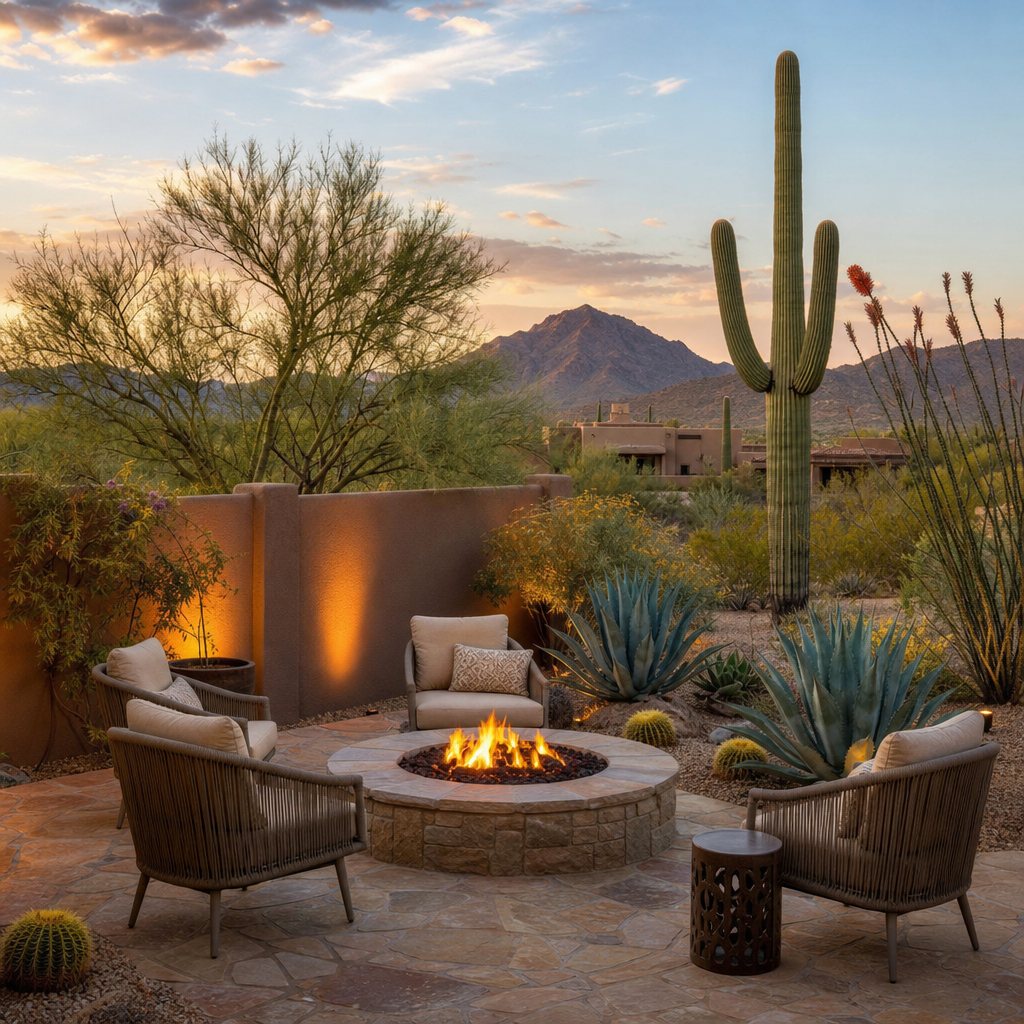
Patios — Paver and Flagstone
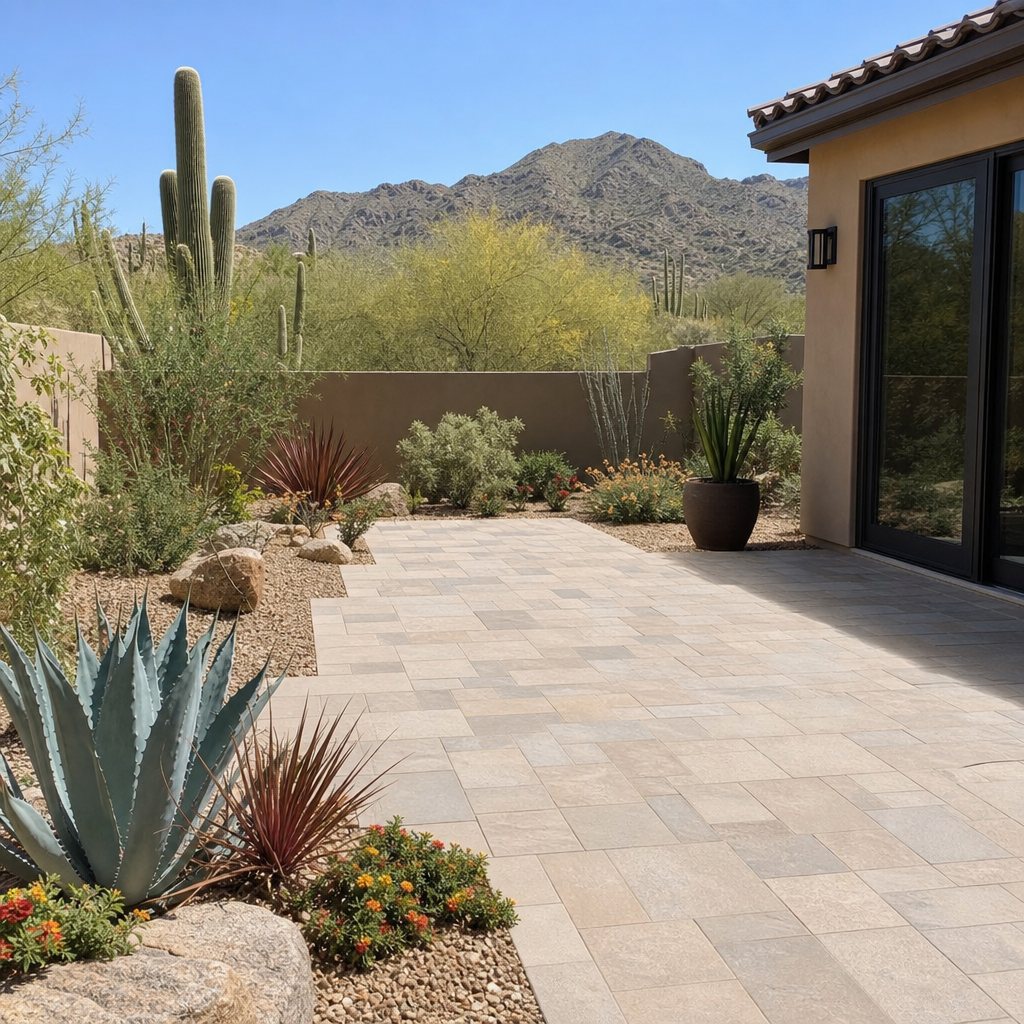
Paver patios use interlocking concrete pavers (Belgard, Pavestone, Unilock) over a 4- to 6-inch compacted crushed-stone base with polymeric sand joints. The steps: excavate 7 to 9 inches below grade, compact #57 stone in 2-inch lifts, screed a 1-inch sand bed, lay pavers with 3mm joints, compact with a plate compactor, and sweep polymeric sand into the joints. Pricing runs $18 to $28 per square foot installed, by paver, pattern, and site access.
Flagstone patios use Arizona fieldstone, Pennsylvania bluestone, or Oklahoma flagstone, by the look you want. Flagstone runs $22 to $35 per square foot installed. Its irregular shape and thickness take longer to install than pavers but give a more natural look that suits desert lots and the regional style across the Valley.
Retaining Walls
Phoenix’s mostly flat terrain still brings retaining walls on many properties: to manage grade between house and yard, to support a slope, or to carve usable flat space out of a tricky backyard. Wall choice depends on height and soil.
For walls under 3 feet, segmental block (Versa-Lok, Keystone, Pavestone) on a proper base and backfill handles most homes. For 3 to 6 feet, we use reinforced systems with geogrid into the backfill for stability. For walls over 4 feet, Arizona code requires engineered drawings from a licensed structural engineer, and we handle that engineering as part of the project.
Every wall we build includes drainage: a perforated pipe at the base behind the wall, #57 stone backfill for the first 12 inches behind the face, and filter fabric between the drainage zone and native soil. Skip any of the three and the wall fails. We do not build them without them.
Fire Pits and Outdoor Features
Gas and wood-burning fire pits are the most-requested outdoor feature in Phoenix. Wood pits (usually 36 to 48 inches across) are simpler and cheaper: a stone or block ring on a non-combustible base, usually $2,500 to $5,000 installed. Gas pits are more complex but offer instant-on, controllable flame. With a gas line, burner pan, media, and ignition, installed cost runs $4,500 to $12,000.
We also install outdoor kitchens, pergolas (we set the structural footings and coordinate the shade build with carpentry partners), and decorative stone accents like boulders, seat walls, and columns.
Why Phoenix Hardscaping Requires Local Expertise
Three things make hardscape different in Phoenix. One: the caliche and clay soil moves with moisture and heat, so a proper crushed-stone base (not sand, not decomposed granite) is a must. Two: extreme summer heat and monsoon rain stress every assembly, so materials have to handle it. Three: caliche, a rock-hard soil layer, can sit at shallow depths. We have hit it at 18 inches in parts of the Valley, which needs pneumatic breakers or rock saws to dig — gear some contractors do not have.
We have built hardscape in these conditions long enough to know the failure points. That is why our standard base is 6 inches in most cases (not the 3 to 4 some crews cut to), why we use polymeric sand on all paver joints (not plain sand), and why every wall gets a perforated drainage pipe even when the design does not strictly require it.
Coordinating with Other Property Work
Hardscape projects coordinate with landscape design (bed lines run against patios and walls), irrigation (line routing through hardscape zones needs planning first), lawn mowing (new hardscape changes mowing patterns), and post-build leaf removal (final cleanup after install).
Request a Hardscape Estimate
Our free on-site estimate includes a site review, a material discussion, and a flat written quote. We quote on actual scope, not “starting at” ranges that balloon during the build. Request a free quote or check our service areas page. Call (602) 782-5412.
How is Hardscaping priced and scheduled in Phoenix?
Most Phoenix customers fall on our standard route schedule. Pricing is locked on the first visit and held for the season — $2,000-$50,000 per project is the typical range. Call (602) 782-5412 for a same-day quote.
What’s Included
- On-site walkthrough with the lead crew member
- Written estimate before any work begins
- Service window confirmed in writing
- Final walkthrough and quality check

Questions About Hardscaping in Phoenix
# How much does a paver patio cost in Phoenix?
Standard paver patios in Phoenix range from $18 to $28 per square foot installed, depending on paver selection (basic concrete paver vs. premium Belgard/Unilock), pattern complexity, and site access. A 300-square-foot patio typically runs $5,500 to $8,500. Flagstone patios run higher at $22-$35 per square foot due to material cost and installation labor.
# Why do Phoenix hardscapes fail so often?
Two reasons dominate: inadequate base preparation (contractors cutting from 6 inches of compacted crushed stone to 3-4 inches to save cost), and missing drainage behind retaining walls. Both failures show up within two winters when freeze-thaw and clay movement stress the structure. Proper base and drainage cost more upfront but eliminate 90% of the failure modes.
# How deep can you dig in Phoenix?
Varies by neighborhood. Much of Phoenix has a shallow layer of soil over caliche, a hardened calcium-carbonate layer. In parts of the north Valley and foothills we hit caliche or rock 12-18 inches down. For deep hardscape work (footings, drain trenches), we come equipped with pneumatic breakers and rock saws to cut through caliche and rock when encountered.
# How long does a paver patio last in Phoenix?
A properly installed paver patio in Phoenix should last 25-30 years or more with minimal maintenance. Key factors: 6-inch compacted crushed-stone base, proper grading away from the house at 1-2% slope, polymeric sand joints (re-application every 7-10 years), and occasional pressure wash with paver-safe cleaner.
# Do you handle engineering for tall retaining walls?
Yes. Walls over 4 feet tall require engineered design drawings from a licensed Arizona structural engineer per state code. We coordinate the engineering as part of the project scope — you don't hire the engineer separately. For walls under 4 feet, no engineering is required and we design-build directly.
# Can I add a fire pit to an existing patio?
Yes, if the existing patio was installed with proper base and is structurally sound. Gas fire pits require running a gas line (usually from the house manifold or a propane tank) and a non-combustible base area. Wood-burning pits are simpler — we can install a stone or block ring on most existing patios with minor prep work.